

Planning a wedding in just six months may sound overwhelming, but it's more achievable than most couples think. With the right timeline, clear priorities, and a structured wedding planning checklist, you can organize a memorable celebration without sacrificing quality or your sanity.
Whether you've chosen a short engagement by preference or circumstance, this guide will walk you through every stage of planning from setting your budget and booking vendors to sending invitations and preparing for your wedding day.
Quick Answer: Yes, you can successfully plan a wedding in six months. The key is to secure your venue and priority vendors within the first month, keep your guest list realistic, and follow a month-by-month planning timeline instead of trying to do everything at once.
This guide includes a complete 6-month wedding planning timeline, printable-style planning checklist, budget allocation table, vendor booking priority guide, wedding dress timeline, money-saving strategies, common mistakes to avoid, expert planning tips, and frequently asked questions.
By the end of this guide, you'll know exactly what needs to happen each month so your wedding day feels organized, enjoyable, and stress-free.
Can You Really Plan a Wedding in 6 Months?
Quick Answer: Absolutely. A six-month engagement provides enough time for most couples to plan a beautiful wedding, provided they make key decisions early and stay organized throughout the process.
While many weddings are planned over 12 to 18 months, shorter engagements have become increasingly common. Many couples actually prefer them because they reduce decision fatigue, encourage faster decision-making, and allow them to focus on what truly matters.
Rather than spending a year comparing dozens of venues or photographers, couples planning within six months often make confident decisions based on their priorities.
Why More Couples Are Choosing Short Engagements
Short engagements are no longer unusual. Couples today often prioritize convenience, financial planning, and flexibility over lengthy wedding preparations.
Some of the most common reasons include wanting to begin married life sooner, family schedules or international travel considerations, military deployments, venue availability, religious or cultural timelines, avoiding long-term wedding planning stress, and taking advantage of off-season venue availability.
A shorter engagement also reduces the temptation to continuously upgrade or change decisions, helping many couples stay closer to their original budget.
Is a 6-Month Wedding Timeline Right for You?
Not every wedding is suited to a compressed planning schedule. A 6-month timeline works well if your guest list is under 200, your wedding is local, you have a flexible wedding date, ready-to-wear attire is acceptable, vendors still have availability, and you enjoy making decisions quickly. Consider 8 to 12 months if your guest list exceeds 300, you want a destination wedding, you need a peak-season venue, you want custom couture outfits, you want highly customized décor, or you prefer extended planning.
Expert Insight: The size of your guest list has a greater impact on your planning timeline than almost any other factor. Smaller weddings are naturally easier to organize within six months because they require fewer logistics, vendors, seating arrangements, and accommodations.
Pros and Cons of Planning a Wedding in 6 Months
Like every planning timeline, six months comes with advantages and trade-offs. Understanding both helps you set realistic expectations.
Advantages
Faster Decision-Making: When time is limited, couples spend less time overthinking every detail. Instead of comparing dozens of photographers or florists, you'll naturally focus on vendors who align with your budget and vision.
Less Planning Fatigue: Planning a wedding for over a year can become emotionally exhausting. A shorter engagement keeps the excitement alive because you're constantly making progress toward your wedding day.
Better Budget Control: Long planning periods often lead to unnecessary upgrades and impulse purchases. A six-month schedule encourages intentional spending, helping couples prioritize experiences that matter most.
Earlier Start to Married Life: Many couples simply don't want to wait another year. A shorter timeline allows you to begin your next chapter together much sooner.
Challenges to Prepare For
Limited Venue Availability: Popular venues and photographers are often booked 12 to 18 months in advance. Be prepared to consider Friday or Sunday weddings, explore boutique venues, ask about cancellations, and look at all-inclusive wedding venues.
Wedding Dress Lead Times: Most custom wedding dresses require six to nine months for production. Fortunately, there are excellent alternatives including ready-to-wear bridal collections, sample sales, off-the-rack gowns, and rush-order services.
Guest Scheduling: Friends and family may already have vacations or other commitments. Sending invitations earlier than usual helps maximize attendance.
Rush Fees: Some vendors charge additional fees for compressed timelines. Always ask about alteration fees, invitation printing deadlines, floral ordering cutoffs, and rental delivery schedules.
The Four Decisions That Shape Your Entire Wedding
One of the biggest mistakes couples make is booking vendors before establishing a clear foundation. Before signing any contracts, agree on these four decisions together.
1. Set a Realistic Wedding Budget
Your budget determines every major wedding decision, from your venue and guest count to your catering options and décor. Start by answering three simple questions: how much can we comfortably spend, is anyone contributing financially, and what's our maximum spending limit. Then divide your budget into categories: venue and catering 40 to 50 percent, photography and video 10 to 15 percent, wedding attire 8 to 10 percent, entertainment 7 to 10 percent, flowers and décor 8 to 10 percent, stationery 2 to 3 percent, transportation 2 to 5 percent, marriage license and officiant 2 percent, and contingency fund 5 to 10 percent.
Planner's Tip: Reserve at least 10% of your budget for unexpected expenses. Rush fees, last-minute rentals, and small upgrades are common when planning within six months.
2. Finalize Your Guest List Early
Your guest count influences nearly every wedding decision, including venue capacity, catering costs, invitation quantities, rental inventory, transportation, and wedding budget. A practical strategy is to create two guest lists: an A-list of people you absolutely want at your wedding, and a B-list of guests you'll invite if space becomes available after RSVPs. This approach keeps your planning flexible without exceeding your budget.
3. Decide Your Non-Negotiables
Every couple values different aspects of their wedding. Before researching vendors, each partner should independently write down their top three priorities, such as photography, exceptional food, live entertainment, luxury venue, floral installations, guest experience, or wedding film. Compare your lists and identify shared priorities. When unexpected compromises arise, these priorities become your decision-making guide.
Expert Insight: Couples who clearly define their priorities early often experience fewer disagreements because they already know where they're willing to compromise.
4. Choose One Wedding Planning System
The most organized couples aren't using dozens of apps. They're using one system consistently. Popular options include Google Sheets, Notion, wedding planning apps, printable wedding binders, and shared digital calendars. Whatever you choose, make sure both partners can access and update it. Consistency matters more than the tool itself.
Your Week-One Wedding Planning Checklist
Complete these tasks during your first seven days: set your wedding budget, estimate your guest count, choose your preferred wedding style, list your top three priorities, create a shared planning workspace, research venues, shortlist photographers, discuss possible wedding dates, create a dedicated wedding email address, and start collecting inspiration without making purchases.
Key Takeaway: The first week isn't about booking everything, it's about creating a strong foundation. Couples who establish their budget, guest list, and priorities before contacting vendors consistently make faster, better decisions throughout the planning process.
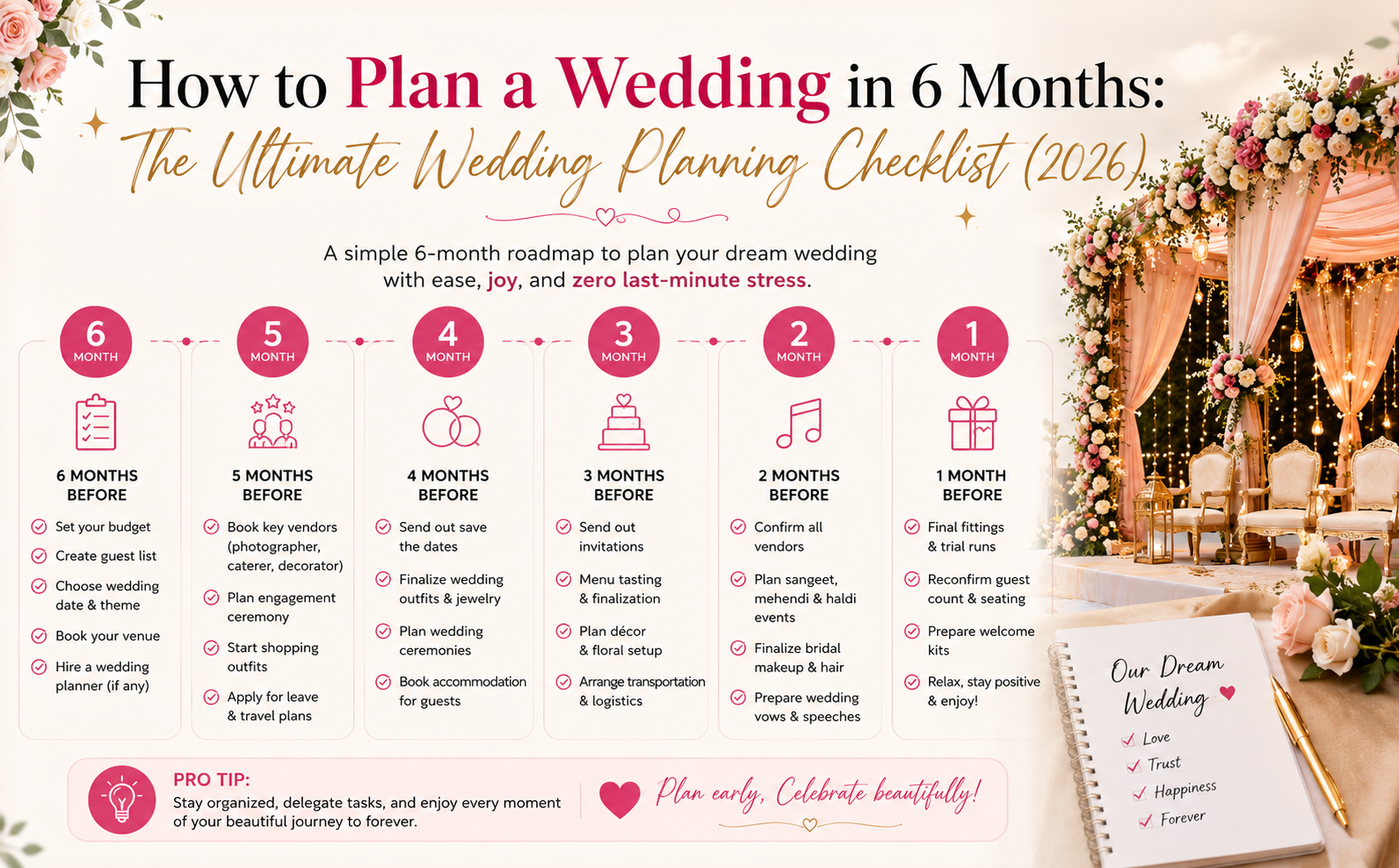
The Complete 6-Month Wedding Planning Timeline
Quick Answer: The most successful six-month wedding plans follow a simple principle. Book the biggest, hardest-to-secure vendors first. Everything else, from invitations to flowers and décor, can be built around those core decisions.
Instead of trying to plan everything simultaneously, focus on one milestone each month. This approach prevents overwhelm while ensuring nothing important gets missed.
Planner's Tip: Treat every month like a mini project. Complete that month's priorities before moving to the next one.
Month 1: Build the Foundation and Lock the Big Three
Primary Goal: Secure your wedding date, venue, and essential vendors. The first month is by far the most important. Every delay during Month 1 creates a ripple effect that makes the remaining months more stressful.
Week 1: Finalize Your Budget. Review your estimated spending one last time, including your wedding budget, emergency reserve, family contributions, personal savings, and monthly payment schedule. Avoid stretching your budget based on maybe income or future bonuses.
Decide Your Guest Count. Don't wait until invitations. Estimate your guest count immediately because it affects venue size, catering quote, rental costs, floral budget, transportation, and wedding favors.
Expert Tip: Every additional guest impacts multiple areas of your budget, not just the meal.
Choose Your Wedding Style. Don't spend weeks debating aesthetics. Choose a general direction such as classic, modern, garden, luxury, minimalist, bohemian, destination-inspired, or traditional. Once the style is decided, every future decision becomes easier.
Week 2: Book Your Wedding Venue. Your venue should be the first contract you sign because it determines every other wedding decision. When comparing venues, evaluate more than appearance. Ask whether your preferred date is available, what's included in the rental, whether tables and chairs are provided, whether there's an in-house coordinator, whether you can choose outside vendors, whether there's a rain backup plan, what time setup begins, what time cleanup must finish, whether there are overtime charges, and what the cancellation terms are.
Planner's Tip: Couples planning within six months should strongly consider all-inclusive venues because they reduce planning complexity by bundling catering, rentals, staffing, and coordination into one contract.
Book Your Photographer immediately after your venue. Photographers often reach capacity before florists, DJs, or decorators. When comparing photographers, look at full wedding galleries, editing style, backup equipment, delivery timeline, contract terms, cancellation policy, and number of photographers included.
Book Your Caterer. If your venue doesn't include catering, this becomes your next priority. Schedule tastings immediately and compare menu flexibility, dietary accommodations, children's meals, staff-to-guest ratio, beverage packages, cake-cutting fees, and late-night snacks.
Hire Your Officiant. Many couples overlook this until the last minute. Book them early regardless of whether you're having a religious ceremony, civil ceremony, friend officiating, or celebrant.
Week 3: Create Your Wedding Website. Your wedding website becomes your communication hub and should include the wedding date, ceremony location, reception location, dress code, accommodation options, travel information, RSVP page, registry, and FAQ. This reduces dozens of repetitive guest questions later.
Reserve Hotel Room Blocks if guests are traveling. Ask hotels about group discounts, complimentary rooms, shuttle services, breakfast, and cancellation policies.
Week 4: Announce Your Date. Before sending Save the Dates, personally inform parents, grandparents, the wedding party, immediate family, and VIP guests traveling internationally. This helps avoid scheduling conflicts.
Month 2: Build Your Vendor Team
Primary Goal: Book every vendor that significantly affects the guest experience. Now that your venue is secured, it's time to build your wedding team.
Book Entertainment. Music shapes the atmosphere more than almost any décor element. Choose between a DJ, live band, solo musician, string quartet, or cultural performers, and ask about backup equipment, song requests, ceremony audio, cocktail hour music, reception timeline, and overtime pricing.
Hire Your Florist. Bring venue photos, inspiration images, color palette, and budget. Instead of asking how much flowers cost, ask what floral designs fit your budget. This results in far more realistic proposals.
Buy Your Wedding Dress. If you're planning a wedding in six months, avoid custom-made gowns unless rush production is available. Instead, prioritize ready-to-wear collections, sample dresses, off-the-rack boutiques, and designer sample sales.
Schedule Alterations immediately after purchasing your dress. A typical schedule includes the first fitting eight weeks before the wedding, the second fitting four weeks before, and the final fitting one to two weeks before. Waiting too long may limit appointment availability.
Order Groom and Wedding Party Attire, coordinating suit color, tie, shoes, accessories, bridesmaid dresses, and groomsmen attire, and don't forget alteration appointments.
Choose Your Wedding Party, finalizing the maid or matron of honor, best man, bridesmaids, groomsmen, flower girl, and ring bearer. Discuss expectations early, including dress costs, bachelor and bachelorette events, rehearsal attendance, and day-of responsibilities.
Send Save-the-Dates. For a local wedding, send them immediately. For a destination wedding, send them digitally as soon as possible. Include the date, city, and wedding website. Detailed logistics can follow later.
Common Mistakes to Avoid During Months 1 and 2: booking your venue before confirming your budget; buying a dress before selecting your venue and wedding style; forgetting to ask vendors about cancellation policies; waiting too long to reserve hotel room blocks; trying to contact every vendor in your city instead of narrowing your shortlist first; and ignoring contract details such as payment schedules, overtime fees, and rush charges.
Key Takeaway: By the end of Month 2, your wedding should no longer feel like an idea. It should have a confirmed venue, key vendors, attire in progress, and a clear direction.
Month 3: Finalize Your Design, Invitations, and Guest Experience
Primary Goal: Turn your wedding vision into a concrete plan by confirming your design, sending invitations, and booking the remaining vendors. By Month 3, your biggest decisions should already be behind you.
Finalize Your Wedding Theme and Color Palette. A cohesive wedding doesn't require an extravagant budget, it requires consistency. Choose one primary style such as modern minimalist, romantic garden, luxury black tie, rustic chic, coastal, traditional, bohemian, or contemporary elegance, and let it influence your floral arrangements, table settings, wedding stationery, ceremony backdrop, wedding attire, lighting, signage, and guest favors.
Planner's Tip: If you're struggling to choose between multiple styles, focus on your venue. Let the architecture and surroundings guide your design decisions instead of trying to transform the space completely.
Send Your Wedding Invitations. For a six-month engagement, wedding invitations should typically be mailed 10 to 12 weeks before the wedding, giving guests approximately three weeks to RSVP. Include ceremony details, reception details, dress code, RSVP deadline, wedding website, and accommodation information.
Book Hair and Makeup. Professional beauty services often book several months in advance. Schedule a hair trial, makeup trial, and wedding day timeline. Bring inspiration photos, but remain flexible based on your stylist's recommendations.
Reserve Transportation if required, confirming bridal party vehicles, guest shuttles, airport transfers, and hotel transportation.
Book Your Rehearsal Dinner Venue, typically inviting immediate family, wedding party, officiant, and out-of-town guests.
Reserve Accommodation Blocks by following up with hotels to ensure your reserved room blocks remain available, and update your wedding website with booking deadlines, discount codes, and hotel contact information.
Month 4: Focus on the Details
Primary Goal: Finalize design decisions, complete legal requirements, and begin preparing for the wedding day itself. By Month 4, the major planning is complete, and it's time to refine every detail.
Schedule Your Cake Tasting to discuss cake flavors, filling options, dietary requirements, display table, delivery timing, and cake-cutting arrangements.
Meet with Your Florist to review ceremony flowers, reception centerpieces, bridal bouquet, boutonnieres, floral arch, and welcome sign arrangements, and confirm delivery times, setup schedule, and breakdown responsibilities.
Attend Your First Dress Fitting, which usually focuses on length adjustments, bust fitting, waist alterations, and sleeve modifications.
Build Your Wedding Registry, including gifts across multiple price ranges such as kitchen essentials, home décor, travel funds, experiences, and charitable donations.
Apply for Your Marriage License. Requirements vary depending on where you're getting married, so research waiting periods, required documents, identification, witness requirements, and expiration dates.
Month 5: Confirm Everything
Primary Goal: Eliminate uncertainty. Month 5 is all about confirming details rather than making new decisions.
Track RSVPs as deadlines pass, contacting non-responders, finalizing your guest count, notifying your caterer, and updating seating plans.
Create Your Seating Chart, considering family relationships, friend groups, elderly guests, children, and accessibility.
Confirm Every Vendor individually, verifying arrival time, setup time, contact person, final payment, timeline, and parking instructions.
Attend Your Second Dress Fitting, focusing on fine adjustments, bustle demonstration, walking comfortably, and sitting comfortably.
Finalize Your Ceremony, reviewing readings, processional order, music, personal vows, ring exchange, and unity ceremony if applicable.
Month 6: The Final Countdown Before Your Wedding
Primary Goal: Confirm every detail, delegate responsibilities, and enjoy the final days before saying I do. By now, every major decision should be complete.
Complete Your Final Dress Fitting, typically one to two weeks before your wedding, walking comfortably, sitting down, dancing briefly, practicing walking upstairs, confirming bustle placement, and checking hem length.
Make Final Vendor Payments, preparing final balances, tips, vendor envelopes, and receipts in a payment folder.
Confirm Every Vendor One Last Time, contacting everyone a week before the wedding to confirm arrival time, setup location, parking instructions, contact person, and timeline.
Create Your Wedding Day Timeline, sharing it with your photographer, videographer, DJ, caterer, wedding planner, wedding party, and immediate family.
Pack a Wedding Day Emergency Kit with clothing essentials, beauty essentials, health essentials, technology, and comfort items.
Delegate Wedding Day Responsibilities, assigning vendor questions, guest assistance, gifts and cards, the emergency kit, timeline coordination, and transportation to trusted people. Your only job on your wedding day should be enjoying it.
Attend Your Rehearsal, practicing the processional, recessional, seating arrangements, microphone use, timing, and readings.
The Night Before Your Wedding should be about rest, not problem-solving. Eat a proper dinner, drink plenty of water, charge your phone, lay out everything you'll wear, confirm your morning schedule, and go to bed early.
Venue Strategy for a 6-Month Wedding
If you're planning within six months, choosing the right venue is one of the biggest factors in reducing stress. Consider boutique hotels, restaurants, country clubs, vineyards, historic estates, art galleries, and all-inclusive venues.
Why All-Inclusive Venues Save Time: instead of hiring separate vendors for catering, tables, chairs, linens, staff, and coordination, many venues provide everything under one contract, reducing emails, vendor meetings, logistics, and payment schedules.
Vendor Booking Priority: if vendors have limited availability, book them in this order: venue, photographer, caterer, officiant, planner or coordinator, DJ or band, florist, hair and makeup, transportation, cake, rentals, photo booth, live painter, and specialty entertainment.
Wedding Dress Options for a 6-Month Timeline
Custom gowns usually require 6 to 9 months. Instead, choose ready-to-wear collections, sample gowns, off-the-rack bridal boutiques, or rush-order options, which often cost less while fitting your planning timeline.
Budget Hacks for a 6-Month Wedding
Planning quickly doesn't always mean spending more. Ways to reduce costs include choosing Friday or Sunday weddings, considering off-season dates, using seasonal flowers, skipping wedding favors, offering digital RSVPs, limiting late-night snacks, and using one venue for both ceremony and reception.
Frequently Asked Questions
Can you really plan a wedding in six months? Yes. Most couples can successfully plan a wedding in six months by booking their venue and key vendors early, staying organized, and following a structured month-by-month timeline.
Is six months enough time to buy a wedding dress? Yes, provided you choose a ready-to-wear, sample, or off-the-rack gown. Custom dresses often require more time.
Should we hire a wedding planner? If you're planning more than 150 guests, multiple venues, a destination wedding, or a luxury celebration, hiring at least a day-of coordinator is highly recommended.
Is a weekday wedding worth considering? Absolutely. Weekday weddings often offer better venue availability, lower prices, and greater vendor flexibility.
What's the hardest part of planning a wedding in six months? The biggest challenge is securing your preferred venue and vendors before they're booked by other couples.
Should we elope instead? Consider eloping if your guest list is under 20 people, you prefer a private celebration, your timeline is under three months, or travel is your priority.
Final Thoughts
Planning a wedding in six months may feel ambitious, but it's entirely achievable with the right strategy. Instead of trying to perfect every detail, focus on what truly matters: marrying the person you love, creating meaningful memories, and celebrating with your closest friends and family.
Start with your venue, build your vendor team, stay organized month by month, and don't be afraid to delegate responsibilities. Remember, guests won't remember every centerpiece or place card, but they will remember how your wedding made them feel.